Your child is bright. You can see it. But reading, writing, or focusing in class may still feel difficult, and regular tuition may not be enough.
This is where educational therapy comes in. Unlike tuition, it does not work through the syllabus. It looks at the why: why reading feels hard, why attention slips, and why words may get jumbled on the page. Educational therapy in Singapore is a structured, 1:1 intervention that supports the learning skills behind schoolwork, not just the symptoms showing up in marks.
This guide covers what educational therapy actually is, who it helps, what sessions look like, how fees are usually estimated, and how to decide if it is the right step for your child.
What Is Educational Therapy?
Quick Answer: Educational therapy is a personalised, 1:1 learning intervention for children with dyslexia, ADHD, developmental delays, or other learning differences. Unlike tuition, it targets the underlying learning skills, such as attention, memory, phonological awareness, and processing speed, that can make academic work feel hard. Sessions are often 60 minutes, once or twice a week. Fees are usually estimated based on the child’s needs and the matched professional’s experience, skills, and qualifications.
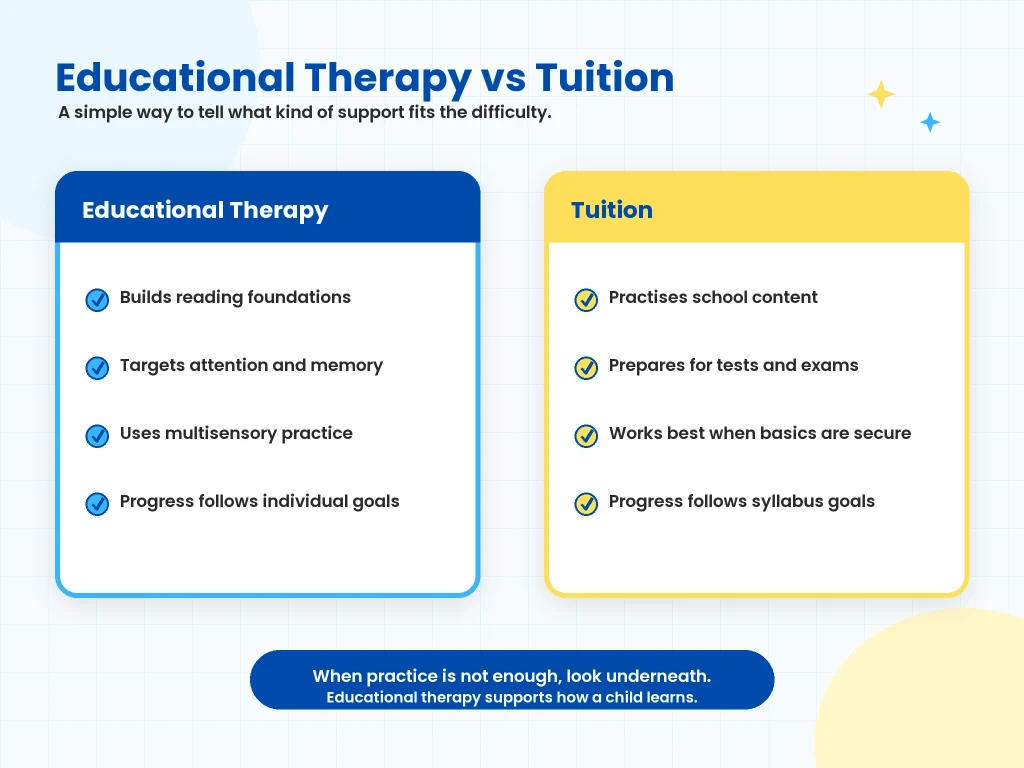
Educational therapy sits between tuition and clinical therapy. It is not revision of school content, and it is not counselling. It is structured, evidence-based support that teaches a child how to learn, often using multisensory methods adapted to their specific profile.
A trained educational therapist will assess your child’s learning gaps first. They look at auditory processing, visual perception, working memory, phonological awareness, and executive functioning, which are the cognitive building blocks that sit beneath reading, spelling, writing, and maths. From there, they build an individualised programme.
Sessions often include:
- Structured literacy using Orton-Gillingham-based approaches (widely used for dyslexia)
- Attention and self-regulation strategies for children with ADHD
- Numeracy skills through concrete-to-abstract methods (not just drilling sums)
- Study skills, organisation, and independent learning habits
A diagnosis is not always required to start. Many families begin educational therapy when they see a child struggling consistently, even before a formal assessment.

Who Is Educational Therapy For?
Educational therapy is most commonly recommended for children with:
- Dyslexia: difficulties with reading, spelling, decoding, and phonological awareness
- ADHD: attention, focus, impulsivity, and executive function challenges
- Dyscalculia: persistent difficulty with number sense and maths reasoning
- Dysgraphia: struggles with written expression, letter formation, or written organisation
- Developmental delays: including children coming through early intervention programmes
- General learning struggles: children in mainstream school who are falling behind without a clear diagnosis
In Singapore’s context, many families come to educational therapy after a child’s school has flagged concerns, after a dyslexia or ADHD assessment through a hospital or private clinic, or after noticing that extra tuition is simply not helping.
Children do not need to be in SPED school to benefit. Most children who access private educational therapy in Singapore attend MOE mainstream primary or secondary schools.
Educational therapy works well alongside other support. A child receiving speech and language therapy for language processing may also benefit from educational therapy to strengthen literacy skills. The two approaches are complementary, not competing.
What Happens in a Session?
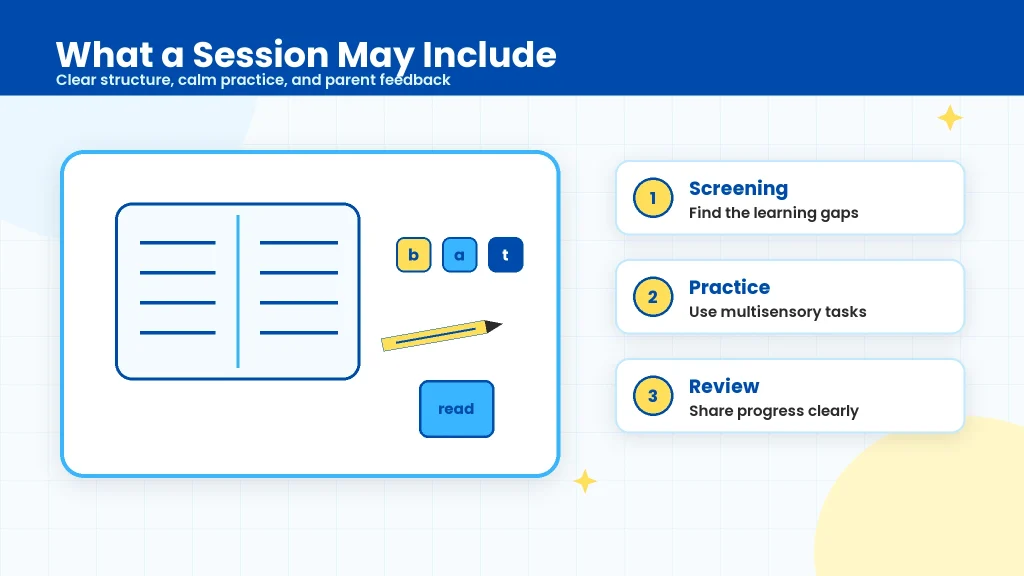
The first step is usually an initial consultation and screening, typically 60 to 90 minutes. The therapist talks with the parents, observes the child, and may use standardised tools (such as WRAT for reading/spelling or TAPS for auditory processing) to identify where the gaps are.
From there, sessions usually run:
- 60 minutes, once or twice a week
- 1:1 format: no group settings for core intervention work
- Regular progress reviews shared with parents, often with input from the child’s school
What you will see in a typical session depends on the child’s profile, but may include phonics-based reading work, spelling patterns, comprehension strategies, or attention-building activities. Good therapists also give parents practical strategies to reinforce between sessions, with small activities at home that compound the work done in the room.
Progress is measured against individual goals, not against grade-level norms. The aim is for the child to build transferable skills that reduce their dependence on external support over time.
Educational Therapy Fees in Singapore
Educational therapy fees in Singapore vary by provider, session format, and the professional’s experience, skills, and qualifications. Special Minds’ own estimated fees guide lists Educational Therapy under Therapy/Counselling as an estimated hourly range, but the exact rate is confirmed based on the matched service professional and the child’s needs.
This is why it is safer to treat any published fee as a guide, not a fixed rate. Families can share their budget and requirements when submitting a request, and the coordinator will try to match them with a suitable professional.
For families seeking subsidised literacy support, the Dyslexia Association of Singapore (DAS) runs a Main Literacy Programme for children with a dyslexia diagnosis. Eligibility, subsidy level, and programme fit should be checked directly with DAS.
A few practical points:
- Home-based sessions may cost more than centre-based sessions because of travel time
- Weekend or high-demand slots may be more limited
- Assessments, if recommended, are usually quoted separately by the relevant clinic or professional
Some families use educational therapy alongside shadow teacher support for children who need both in-school and out-of-school support, especially children with ADHD or autism who are navigating mainstream school.
There is currently no MediSave or MediShield coverage for private educational therapy in Singapore. Families may wish to check with their insurer whether any supplementary insurance covers developmental or learning support.
How Educational Therapy Differs from Speech Therapy and Tuition
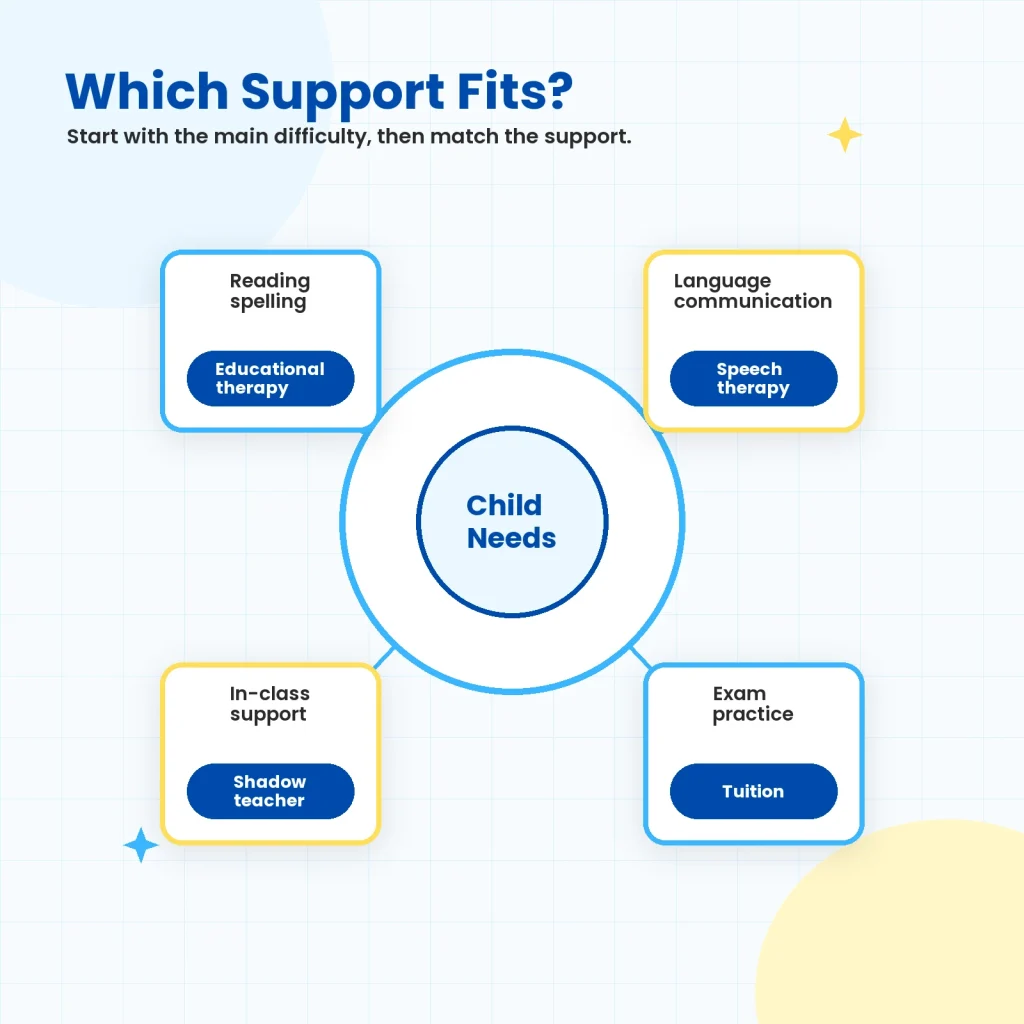
Parents often ask whether their child needs educational therapy, speech therapy, tuition, or all three. Here is a practical way to think about it:
If your child struggles with reading, spelling, or phonics, educational therapy is the more direct route. Speech therapy addresses communication and language at a foundational level; educational therapy takes those building blocks and applies them specifically to literacy and academic learning.
If your child has trouble understanding spoken instructions, or has a language delay, speech and language therapy should come first or run alongside educational therapy.
If your child understands the work but needs more practice or exam prep, tuition is likely sufficient.
If your child finds learning genuinely hard despite effort, and the problem is not about content knowledge, educational therapy is designed for exactly this scenario.
Many children in Singapore benefit from more than one type of support, especially during primary school years when foundational skills are built. The key is getting the right match between the intervention and the actual difficulty.
Frequently Asked Questions
What age can a child start educational therapy in Singapore?
Educational therapy is most commonly accessed for primary school children (ages 6 to 12), but can start earlier for children with developmental delays, often as a follow-on from early intervention. Older children in secondary school also benefit, particularly when executive functioning, organisation, or study skills are the core issue.
Does my child need a diagnosis to start?
No. Many educational therapists in Singapore work with children who have not yet received a formal diagnosis of dyslexia or ADHD. An initial assessment with the therapist will map out where the gaps are and what kind of support is needed. A formal diagnosis may be recommended if the assessment suggests it, but it is not a prerequisite to begin.
How long does educational therapy take to show results?
Most families notice change within 8 to 12 weeks of consistent sessions (once or twice a week). Significant skill shifts, such as improved independent reading or spelling accuracy, typically require 6 to 12 months of sustained work. Educational therapy is not a quick fix; it is a structured process of rebuilding foundational skills.
Can educational therapy be done online in Singapore?
Yes. Several centres offer online educational therapy sessions, which can reduce cost and travel time. Online delivery works well for children who are able to focus on a screen and for skill areas like reading comprehension and maths reasoning. For younger children or those who need more hands-on multisensory work, in-person sessions are generally preferred.
How is an educational therapist different from a special needs tutor?
An educational therapist typically holds qualifications in special education, educational psychology, or a related field, and uses structured, evidence-based programmes (such as Orton-Gillingham) to target specific cognitive and learning processes. A special needs tutor may have training in supporting children with learning differences but usually delivers support at the academic content level rather than the cognitive-process level. For children with diagnosed learning differences, an educational therapist usually provides more specialised and structured support.
Does Special Minds offer educational therapy?
Special Minds connects Singapore families with qualified educational therapists and other learning support professionals. Contact us to discuss your child’s profile and find the right match.
What to Do Next
If your child is finding school genuinely hard, not for lack of trying, but because reading, writing, or focusing feels difficult every day, educational therapy is worth exploring.
Start with a conversation. An initial consultation will tell you whether educational therapy is the right fit, or whether another type of support would serve your child better first.
Special Minds works with families across Singapore to match children with the right therapists and support professionals. Reach out via our contact page and we will help you work out what your child needs.
Special Minds | Educational Therapy & Learning Support | Singapore