Singapore has 26 government and community-funded SPED schools, and that number is rising to 30 by the early 2030s. If your child has just been diagnosed with a developmental or intellectual condition, working out which of these schools fits, and how to apply, is the hard part.
This guide lists every SPED school by the condition it serves, walks through the application timeline, and explains what changed in March 2026 when the Ministry of Education announced its biggest expansion of special education places in over a decade.
What Is a SPED School, and How Many Are There?
Quick Answer: A SPED (special education) school in Singapore is a government-funded school built for children whose special needs mean they cannot access the mainstream curriculum without dedicated support. As of March 2026 there are 26 SPED schools, rising to 30 by the early 2030s under a Ministry of Education expansion, serving around 9,000 students today and roughly 12,000 once the new schools open.
SPED schools sit apart from mainstream schools with learning support. They run smaller classes, staff trained specifically in special needs, and a curriculum built around each child’s profile rather than the national syllabus alone.
Some SPED schools, known as SPED (NC) schools, still follow the national curriculum for students who are cognitively able to take it on with support. Canossian School, Cerebral Palsy Alliance Singapore School (East), Lighthouse School, Pathlight School, and St. Andrew’s Mission School fall into this group.
Most children start SPED school around Primary 1 age and can remain enrolled up to age 18, and in a small number of schools, up to 21.
Special Minds matches families with shadow teachers, tuition, and therapy support alongside the SPED and mainstream school system, whether your child is on a waitlist, has just started, or is staying in mainstream with extra help. Our shadow teacher service is one option families use while a SPED application is still in progress.
The Full Directory: SPED Schools by Condition
Each SPED school is set up around specific conditions, not a general catch-all. Here is the breakdown as of the 2026 expansion announcement.
Autism spectrum disorder, no intellectual impairment. Pathlight School (with campuses in Ang Mo Kio, Tampines, and Punggol), St. Andrew’s Mission School, and Anglo-Chinese School (Academy). These schools blend the mainstream curriculum with life-readiness skills, smaller classes, and staff trained in autism support.
Autism spectrum disorder with intellectual impairment. This is the largest category and the one growing fastest. Current schools include APSN Chaoyang, APSN Tanglin, APSN Katong, AWWA School @ Bedok, AWWA School @ Napiri, MINDS Towner Gardens, Eden School, APSN Delta Senior, Grace Orchard, St. Andrew’s Autism School, Maitri School, MINDS Lee Kong Chian Gardens, the three Rainbow Centre campuses, MINDS Fernvale Gardens, Metta School, and MINDS Woodlands Gardens.
Mild intellectual disability. APSN Chaoyang, APSN Tanglin, APSN Katong, APSN Delta Senior, Grace Orchard, and Metta School.
Moderate to severe intellectual disability. MINDS Towner Gardens, MINDS Lee Kong Chian Gardens, MINDS Fernvale Gardens, and MINDS Woodlands Gardens.
Multiple disabilities. Cerebral Palsy Alliance Singapore School, with campuses in the west and east, and Rainbow Centre Margaret Drive.
Sensory impairment. Lighthouse School, for children who are deaf, hard of hearing, blind, or have low vision.
A school’s application form asks families to list up to three schools that match their child’s primary diagnosed condition, so most of the decision is made for you by the diagnosis itself. The choice families actually make is between the specific campuses within a category.
Campus assignments and category groupings shift as MOE opens new sites, so treat the list above as a starting point and confirm current placements against MOE’s official SPED school directory before applying.
What Changed in the March 2026 Expansion
On 3 March 2026, MOE announced it would grow the number of government and community-funded SPED schools from 26 to 30, adding three new schools and expanding two existing ones. Total capacity rises from around 9,000 students today to roughly 12,000, a 30 percent increase.
The expansion is concentrated in autism spectrum disorder with intellectual impairment, the category with the longest waitlists. Schools serving this group grow from 13 to 16.
MINDS Fernvale Gardens and MINDS Lee Kong Chian Gardens get interim additional campuses from the second half of 2026. MINDS Towner Gardens gets an additional interim campus from 2027, and MINDS Woodlands Gardens relocates to a larger interim site in the north from 2027. Three new ASD-ID schools are being planned in partnership with APSN Education Services, Autism Association (Singapore), and St. Andrew’s Mission Hospital, though they are not yet operating.
If your child is currently on a waitlist in the ASD-ID category, this expansion is the single most relevant piece of news for your application timeline this year, and it is worth mentioning to the school when you check on your application status.
How to Apply: The Timeline Parents Actually Need
Applying to a SPED school is not a same-year process. Families who start early get a smoother run.

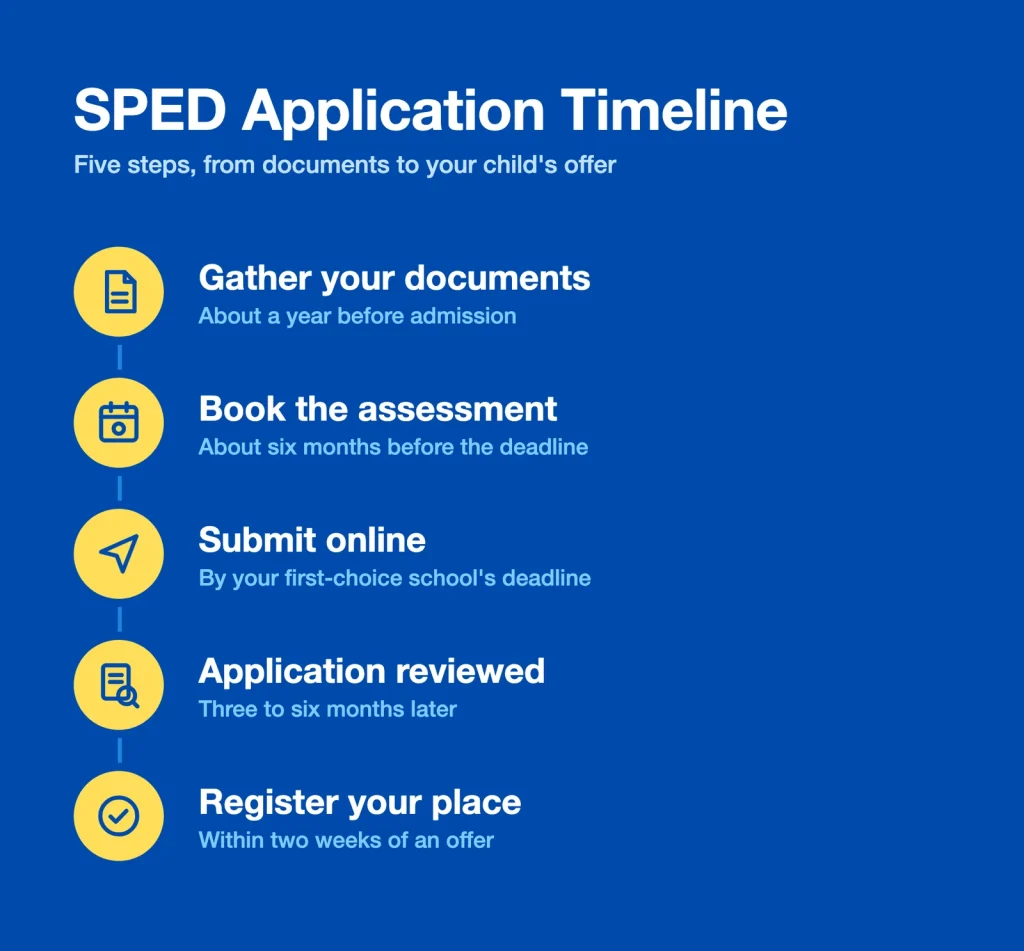
About a year before admission. Start gathering documentation. This includes a medical report from a professional familiar with your child’s history and diagnosis, and a full professional assessment covering physical development, communication, and social-emotional functioning.
About six months before the deadline. Book the professional assessment appointment. This is the step families underestimate. Reports take time to produce, and deadlines vary by school, so working backwards from your first-choice school’s deadline matters.
By the deadline. Submit the online application, listing up to three schools that support your child’s primary diagnosed condition. The form cannot be saved partway through, so have every document ready as a digital copy before you start.
Three to six months later. Your first-choice school processes the application once all documents are in, and may arrange to meet your child. If a place isn’t available or your child is transferring from a mainstream school, MOE’s Educational Psychologists and Special Educational Needs Division step in to review the case and match your child to an alternative school.
Within two weeks of an offer. Families must register. If the first-choice school cannot offer a place, MOE recommends alternative schools based on your child’s needs.
Only Singapore Citizens or Permanent Residents applying for Primary 1 or Junior 1 (Secondary 1 equivalent), or Returning Singaporeans at any level, are eligible through this process. You can read the full requirements and download the current application form on the MOE special educational needs page.
SPED School or Mainstream With Support: What Families Weigh Up
Not every child needs a SPED school, and not every diagnosis leads there. Many children with special needs stay in mainstream school with a Learning Support programme or a shadow teacher, particularly when the condition does not significantly affect access to the standard curriculum.
The decision usually comes down to three things: how much the condition affects classroom learning day to day, whether the child needs specialist therapy built into the school day, and how the child manages socially in a larger mainstream setting.
We see this question constantly in families we match. A child with ADHD or mild dyslexia often thrives in mainstream school with the right in-class support. A child with autism and a significant intellectual impairment usually needs the smaller classes and specialist staffing a SPED school provides.
If your child stays in mainstream while you weigh the options, or while a SPED application is pending, special needs tuitionand one-on-one shadow teacher support are two ways to keep your child progressing without losing time. You can read more in our earlier guide on key signs your child may have special educational needs if you are still at the diagnosis stage.
Frequently Asked Questions
How many SPED schools are there in Singapore in 2026?
There are 26 government and community-funded SPED schools as of the March 2026 announcement, rising to 30 by the early 2030s as MOE adds three new schools and expands two existing ones.
How do I know which SPED school is right for my child?
The application form itself narrows this down. You list up to three schools that support your child’s primary diagnosed condition, so the school category, such as autism with intellectual impairment or sensory impairment, is set by the diagnosis. The remaining choice is usually which campus is most practical for your family.
How old does my child need to be to apply to a SPED school?
Most SPED schools take children from around Primary 1 age. Some schools serve students up to age 18, and a small number, including APSN Delta Senior, take students up to age 21.
Do I need a diagnosis before I apply?
Yes. A professional assessment and a medical report confirming your child’s diagnosis are required documents in the application. Book the assessment appointment around six months before your target school’s application deadline.
What if my child does not get a place at any of my three chosen schools?
MOE will recommend alternative SPED schools based on your child’s assessed needs. Families can also consider mainstream school with a Learning Support programme, or private options such as shadow teacher support, while reapplying.

Making the Right Choice for Your Child
Singapore’s SPED system is expanding faster than at any point in the last decade, and knowing where your child’s diagnosis fits in the 26, soon 30, schools is the first real step.
Start the assessment and documentation process early, apply to schools matched to your child’s specific diagnosis, and use the waiting period to keep your child progressing, whether that is through mainstream support, tuition, or a shadow teacher.
Special Minds matches Singapore families with the specialists and shadow teachers who support children through this process, at no agency fee. Contact Special Minds to talk through your child’s options.