What Is Speech and Language Therapy?
Quick Answer: Speech and language therapy (SLT) is structured support for children who have difficulty communicating. A Speech-Language Pathologist (SLP) works on speech sounds, vocabulary, language comprehension, fluency, voice, and social communication. In Singapore, SLPs must be registered with the Allied Health Professions Council (AHPC) to practise legally.
Speech and language therapy covers a wide range of communication difficulties. People sometimes use “speech therapy” and “language therapy” as if they mean the same thing. There is a practical difference worth knowing.
Speech refers to the physical act of producing sounds. A child with a speech difficulty might drop sounds, substitute one sound for another, or be hard to understand even by people who know them well.
Language refers to understanding and using words and sentences. A child with a language delay might understand instructions but struggle to form sentences, or they might have a large vocabulary but not know how to use it in conversation.
An SLP works across both areas. A full assessment looks at how your child produces sounds, how much they understand, how they express themselves, and how they communicate in social situations.
The six main areas a Speech-Language Pathologist works on are:
- Articulation: how clearly your child produces speech sounds
- Language comprehension: whether your child understands what is said to them
- Expressive language: how your child builds sentences and communicates ideas
- Fluency: smooth, uninterrupted speech; stuttering falls into this category
- Voice: pitch, volume, and quality of your child’s voice
- Social communication: turn-taking, eye contact, and reading conversational cues
There is also oral-motor and feeding therapy, which covers children who have difficulty with the physical movements needed for speech or swallowing.
A speech delay means your child is developing communication skills more slowly than expected for their age. A speech disorder means the pattern of difficulty is different from typical development, not just slower. The distinction matters for how therapy is structured, and an SLP is the right person to assess which applies to your child.
In Singapore, speech-language therapists must hold a degree in speech and language therapy and be registered with the Allied Health Professions Council (AHPC). You can verify any therapist’s registration directly through the AHPC public register.
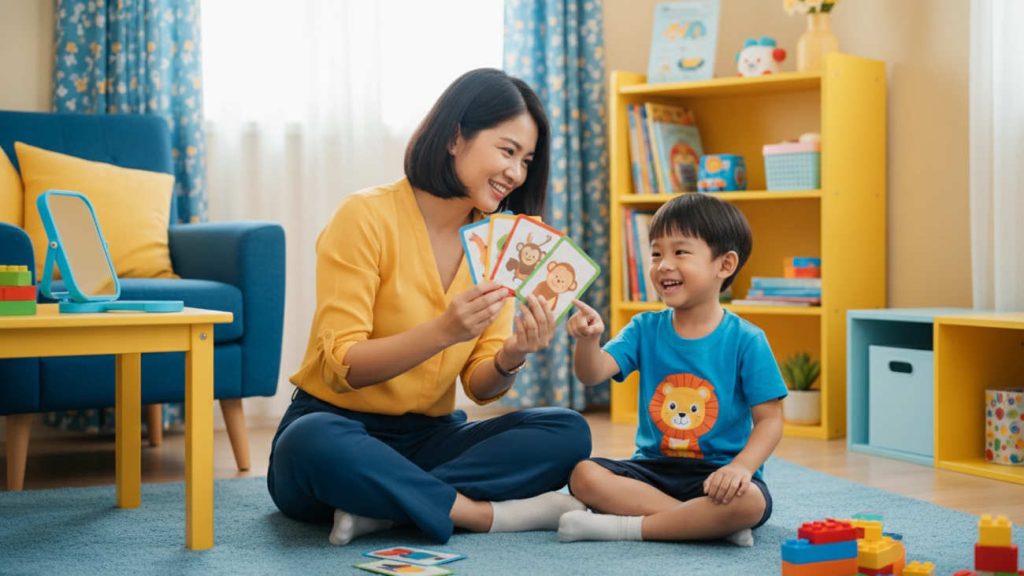
Signs Your Child May Need Speech Therapy in Singapore
Early identification makes a real difference. Singapore’s child health system checks developmental milestones at key ages, including the developmental assessments at 18 months, 2 years, and 3 years done through polyclinics and paediatric clinics.
Here are the red flags parents and doctors look for at each stage:
By 12 months: Your child is not babbling, does not make eye contact, and does not point at objects to show you things.
By 18 months: Your child has fewer than 10 words. They do not point at pictures in a book or follow simple instructions like “come here.”
By 2 years: Your child has fewer than 50 words and is not yet putting two words together, such as “more milk” or “daddy go.” Strangers understand less than half of what your child says.
By 3 years: Your child is not putting three or more words together in short sentences. Strangers understand less than 75% of what they say.
By 4 to 5 years: Your child is leaving out key words in sentences, stammering significantly, or regularly having meltdowns out of frustration when trying to communicate.
These are reference points, not a checklist of certainty. A child can miss one milestone and catch up quickly. But when more than one flag appears, or when something has not improved over a few months, a formal assessment is the right next step.
Common conditions that benefit from speech and language therapy include:
- Late talker with no other developmental concerns
- Autism spectrum disorder (ASD)
- Down syndrome
- Cleft lip or palate
- Hearing loss
- Cerebral palsy
- Childhood apraxia of speech
- Developmental language disorder (DLD)
Early action consistently produces better outcomes. Research shows that the period between birth and age five is when the brain builds language pathways fastest. The same effort at age 7 rarely produces the same results as the same effort at age 3.
How Much Does Speech Therapy Cost in Singapore?
This is usually the first question parents want answered, and it is also the area where information is hardest to find. Here is what parents actually pay in Singapore in 2026.
Private clinic sessions typically cost between SGD 140 and SGD 250 per session for a 45 to 60 minute block. Initial assessments are priced separately and can range from SGD 200 to SGD 850 depending on the assessments required and the complexity of the evaluation. Home visit sessions are usually priced higher than clinic sessions to cover the therapist’s travel.
At Special Minds, AHPC-licensed speech therapy sessions are priced at SGD 200 to SGD 240 per hour. Sessions are billed for the time used, with a minimum of one hour. There are no packages to lock into and no administrative fees charged to families.
Public hospital waitlists at KKH and NUH offer subsidised paediatric speech therapy for Singapore Citizens and Permanent Residents. The subsidy makes these sessions affordable, but demand consistently outpaces supply. Waitlists for new paediatric referrals at public hospitals typically run 6 to 12 months or longer. A paediatrician or GP referral is required to access the public system.
CHAS subsidies (Community Health Assist Scheme) apply to allied health services including speech therapy at registered CHAS GP and polyclinic providers. Check your CHAS card category for the applicable subsidy amount.
Medisave does not cover private speech therapy sessions for children. It can be used for certain MOH-approved medical treatments, but outpatient SLT for developmental delays does not currently qualify.
EIPIC (Early Intervention Programme for Infants and Children) covers speech and language therapy as part of a centre-based early intervention programme for children under 7. Waitlists have historically been 6 to 18 months. Families can start private therapy while an EIPIC application is in progress.
The waitlist reality means many Singapore families use private therapy to bridge the gap or as their primary pathway. At Special Minds, we find that children who start home-based sessions while waiting for a public referral arrive at their first subsidised appointment having already made measurable progress.
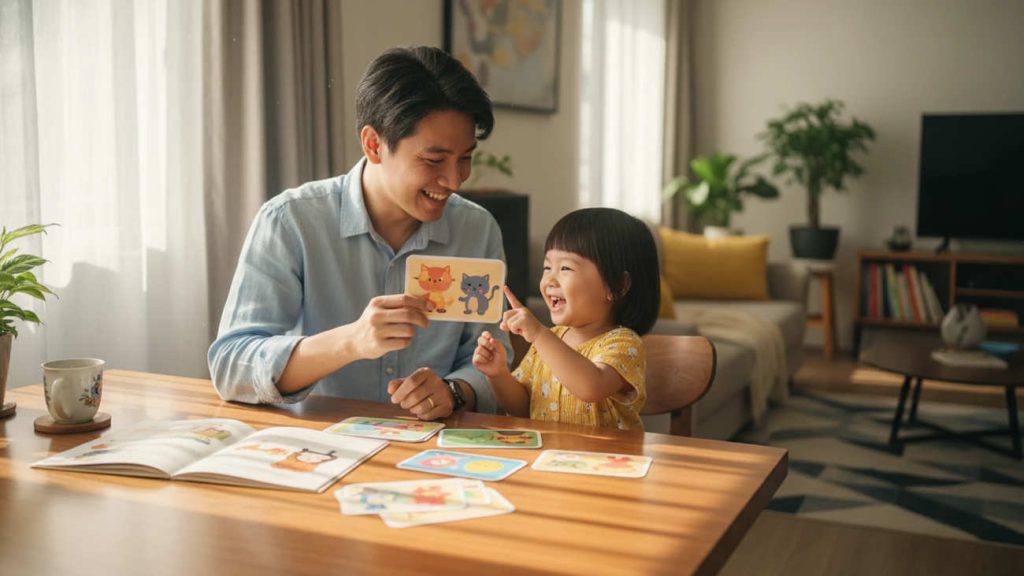
What Happens During a Speech Therapy Session at Special Minds
Every engagement at Special Minds starts with an initial assessment. The SLP evaluates your child across the relevant areas: speech clarity, language comprehension, expressive language, fluency, voice, and social communication. For younger children, this looks like play. For older children, it includes structured tasks alongside observation.
From the assessment, your therapist builds a goal plan. Goals are specific and measurable: not “improve vocabulary” but “use 20 new action words in structured play over 8 weeks.” Each session target connects directly to a goal on the plan.
Sessions are 1:1 and home-based. The therapist comes to your home or, where relevant, your child’s school or childcare setting. This produces a real advantage. When a child practises a skill in their own kitchen, living room, or bedroom, the skill generalises faster. The familiar environment is one less thing for the child to process, so more cognitive space goes toward the actual communication target.
Parents are active participants, not waiting outside. You observe sessions, hear the strategy explanations, and receive specific activities to practise between appointments. Most progress in speech therapy happens between sessions, not during them. The work you do at home matters as much as the session itself.
Progress is reviewed regularly. As your child hits targets, goals are updated. Sessions can be weekly, fortnightly, or arranged around your schedule. There is no lock-in period.
How many sessions does a child typically need? This depends on the type and severity of the communication difficulty and how consistently strategies are reinforced at home. Some children make measurable gains within 2 to 3 months of weekly sessions. Others with more complex profiles benefit from ongoing support over 12 to 24 months. Your therapist will set realistic expectations after the initial assessment.
Speech therapy at Special Minds often runs alongside early intervention support for younger children, or with shadow teacher supportonce a child starts school.
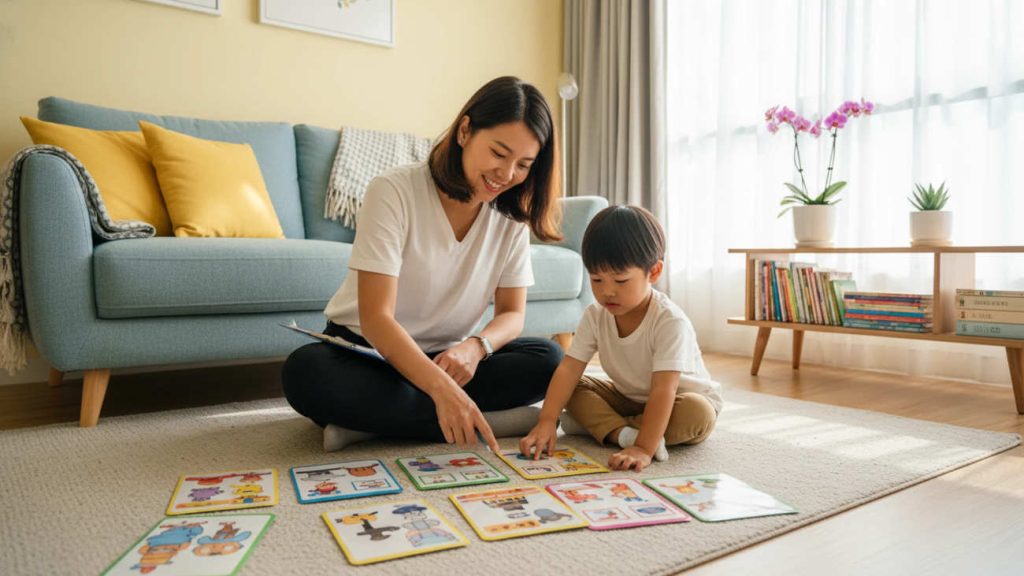
How Speech Therapy Connects to Other Therapies
Communication does not sit in isolation from the rest of your child’s development. For many children who need speech and language therapy, other areas are also in play.
A child with ASD may need speech therapy for language and social communication alongside Applied Behaviour Analysis (ABA) for behaviour and routine management. A child with developmental delays often benefits from occupational therapy (OT) for fine motor skills and sensory processing at the same time as SLT. A child in primary school who needs support in class may benefit from educational therapy for reading and writing alongside speech work.
At Special Minds, the team coordinates across these service areas. If your child is already working with a specialist in one area and speech therapy is added, the therapists communicate directly so the approach stays aligned. This prevents conflicting strategies and means that the goal-setting across services supports one another rather than pulling in different directions.
Working across therapy types also helps parents. Instead of attending different providers at different locations, you work with one coordinating team. Everything is home-based. Your schedule is your schedule.

Frequently Asked Questions
1. At what age should a child start speech therapy?
Children can begin speech therapy as early as 12 to 18 months if concerns are identified. For most families, the first assessment happens between ages 2 and 4 after a developmental check flags a delay. The earlier therapy starts, the more benefit a child receives from the brain’s peak language-building period in the first five years of life.
2. Is speech therapy covered by Medisave in Singapore?
No. Medisave does not cover private outpatient speech therapy for children with developmental delays. CHAS subsidies apply at registered GP and polyclinic providers. KKH and NUH offer subsidised sessions through referral, with income-tested support available through the National Means Testing System.
3. How long does speech therapy take?
This depends on the child’s starting point and the severity of the difficulty. Some children with mild articulation delays see meaningful improvement in 2 to 3 months of weekly sessions. Children with language disorders, ASD, or more complex profiles often benefit from 12 to 24 months of consistent therapy. Your therapist will give you a clearer picture after the initial assessment.
4. What is the difference between a speech therapist and a language therapist?
The correct title in Singapore is Speech-Language Pathologist (SLP). SLPs are trained in both speech (sound production) and language (comprehension and expression). There is no separate profession called a “language therapist” in Singapore. All registered SLPs hold a degree and a valid Practising Certificate from the Allied Health Professions Council (AHPC).
5. Can speech therapy be done at home in Singapore?
Yes. Home-based speech therapy is offered by a growing number of private providers in Singapore, including Special Minds. A qualified SLP comes to your home for each session. The home setting is an advantage for young children because they communicate more naturally in a familiar environment, and skills practised at home tend to carry over into daily life faster than skills practised in a clinic.
6. Do I need a referral for private speech therapy?
No. Private speech therapy providers in Singapore, including Special Minds, do not require a doctor’s referral. You can reach out directly to arrange an initial assessment. A referral is only required for subsidised services at public hospitals such as KKH and NUH.
Ready to Take the Next Step?
Three things to take away from this article.
First, speech and language delays respond best to early action. If a check-up has flagged a concern, or if you’ve noticed something and been unsure what to do, an assessment is the right starting point. It answers the question either way.
Second, the public waitlist is real. KKH and NUH provide strong subsidised services, but new referrals typically wait 6 to 12 months. Private home-based therapy fills that gap without requiring you to choose between systems. Both can run at the same time.
Third, the home-based model works. Children settle faster, parents are involved throughout, and skills practised at home carry over into daily life more consistently than skills practised in an unfamiliar clinic.
If you’re not sure whether your child needs an assessment, reach out to Special Minds for an initial conversation. There is no charge and no commitment for a first discussion. Contact Special Minds to find out more.